BOOKS READ: 7
2026 BOOKS READ: 25/45
Hi Readers,
Please enjoy my June recaps below!
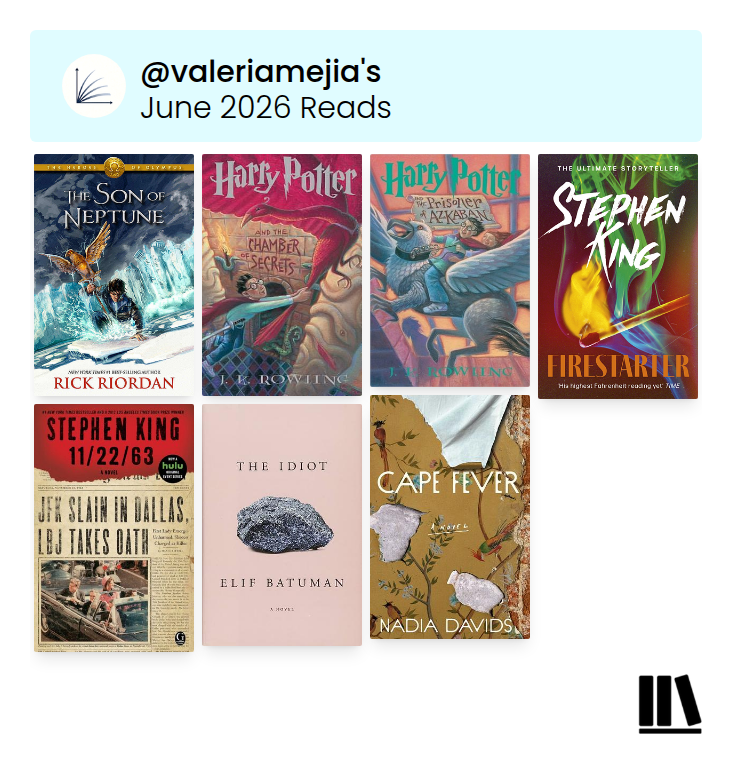
The pictured collage is automatically generated by StoryGraph, please refer to the following compiled reviews for respective ratings.
Cape Fever by Nadia Davids: 5/5 !!
This book, described as a gothic psychological thriller, is definitely one of the best I have read this year. Cape Fever follows a young, Muslim servant woman in 1920 starting a new bout of employment for a very strange and wealthy White woman, directly following the aftermath of WWI.
The plot begins as more of a literary commentary on racial and class disparities present at the time, commendably done as well, but quickly progresses into a mind-boggling game of Twister that left me absolutely dumbfounded. I should add, I tend to cycle through an absurd number of book simultaneously, so any book I read within 2-3 days is almost certainly a 5-star read for me; it genuinely takes a feat of a read to enrapture my attention so wholly, in fact, I take any review or description boasting to be a “can’t-put-down read” as a challenge to my very livelihood, but I must admit to have lost this round.
I am wary to provide much detail on the contents of this book because the shock that followed me throughout the last half ultimately made the entire book a favorite for me and I wouldn’t dare take away from that experience for others, but thematically, I found this read highly comparable to the 2017 film Get Out. I must refrain from further comparisons simply because this book achieved its purpose so well that it truly deserves to be upheld in its own merit, I cannot recommend Cape Fever enough!
The Idiot by Elif Batuman: 4/5
The Idiot is a literary, semi-autobiographical work that follows a freshman Harvard student by the name of Selin. It had a bit of stream-of-consciousness feel to it, and I found myself questioning many of the narrator’s choices, especially those regarding her love interest, but she was ultimately just a silly, teenage girl. Obviously, as a Harvard student, she is likely a bit more of an intellectual than the average teenager, and her way of thinking often confirms this, but it does so while simultaneously and eloquently proving that the smartest teenager is still just a teenager. While she mostly studied languages and linguistics, her love interest, Ivan, was a math student. I found him insufferable, but he prompted some discourse in Selin regarding his area of study, which happens to be mine, that was both thought-provoking and much appreciated.
“What if math turned out to explain how everything worked – not just physics but everything? Could that be what Ivan was studying?” I’ve long vouched for the intersection of math and philosophy, not just hypothetically but historically: the most renowned ancient philosophers were also mathematicians, but I can’t say I’ve ever thought about it in the way it is worded here, or maybe I did and I simply didn’t have the depth to articulate it as such, but isn’t that the beauty of combining different areas of study? This is probably the factor that I enjoyed the most; as a fan of RF Kuang, I can say I wasn’t a huge fan on her interpretations of mathematics in her recent book, Katabasis, compared to her other academic-setting book, Babel. It just came off as the work of someone with little to no interest in math, which is fine of course, except when your main characters are basically studying a magical rendition of math. This is definitely a very niche complaint, but one I’ve heard from other fellow math students that enjoy reading; it is just better suited for readers who do not care for the field and can enjoy the story without a bother for these specifics. Batuman, on the other hand, tailored to this niche perfectly and without feigning an impression of prerequisite knowledge.
This book ended up being way more of a laugh than I expected, with a consistent dry humor, while also riddled with excellent prose and random philosophical tangents. I would say it dragged a little in Part 2, which follows Selin to a Hungarian village for a summer teaching program, but it was worth finishing to follow her substantial growth from the beginning of the book.
11/22/63 by Stephen King: 4.5/5
This book is one of those that I found enjoyable without being particularly discourse inducing. 11/22/63 begins in 2011 and follows a 35-year-old, recently divorced teacher by the name of Jake who is introduced by a friend, Al, to a sort of time travel rabbit-hole that transports one to 1958, always the exact day and time, with the condition that only two minutes have passed when one returns to the present, no matter how long they have spent in the past.
Al, an avid lifelong smoker, is quickly losing a battle to lung cancer and decides Jake would be his best chance in his ambitions to prevent the assassination of JFK on, believe it or not, 11/22/1963. Al believes that preventing his assassination may prevent some of the significant and detrimental events that followed JFK’s death, such as the Vietnam war, the assassination of civil rights leaders including MLK, Malcom X, and Fred Hampton, the ensuing race wars, etc.; the 60’s were a real treat!
Jake is personally motivated to give it a try because one of his adult students in his afternoon GED classes, a janitor (Harry) for the same school, wrote an essay on the tragic, life-altering event in his childhood in which his father gruesomely killed his mother and all his siblings in a drunk fit of rage, also leaving him crippled and near-death but ultimately the only survivor. This tragedy occurred on Halloween of 1958, a mere few months after the time in which the rabbit-hole always lands, which prompts Jake to attempt to prevent this tragedy, because in comparison to the magnitude of a presidential assassination, the long-term impacts of altering this course in history should hypothetically be reasonably minute for everyone but Harry and his family. Jake’s concern regarding Al’s plan is that of any time-travel tale: the butterfly effect; however, it is verified that if one travels to present time and then returns to the past, which always lands at the same 1958 date, the timeline restarts. Thus, Jake could ultimately lose five years of his life in altering or failing to prevent the assassination, but he maintains the ability to take it all back.
King mostly follows the JFK theory of a lone gunman; since the known culprit, Lee Harvey Oswald, was killed the following day, the past 60 years have been open to a mildly ostentatious amount of conspiracy theories and paranoia regarding the depth and conspirators of the assassination. He also follows a theme in which “the past is obdurate”, or will take drastic measures to prevent being changed. King doesn’t take a particularly surprising route, maybe even one mildly disappointing, regarding the result of Jake’s actions, but I enjoy the different perspectives on the butterfly effect and I particularly enjoyed seeing this at such a grand scale. I’ve noticed more often than not, time travel tales are more personally motivated and less “playing God”, which I believe Al and Jake were, for better or worse, attempting to achieve here.
Kindred by Octavia E. Butler, for example, comes to mind as it follows a modern woman’s attempt to preserve the life of an ancestor and in-turn, her own. I think King’s take may actually be more realistic, although to clarify, the main character in Kindred does not have control over her blasts to the past, but I do believe any man with such a power would indeed attempt to play God. Truthfully, I think those who attempt to make it a possibility are already doing so, we’ve certainly seen many men attempt to do so without any otherworldly power; in this novel, however, the rabbit-hole is simply a fluke in the space-time continuum, which is graciously clarified in the last section of the novel.
This book is around 800 pages, nothing absurd for Mr. King but quite treacherous for my remarkably low attention span, and yet somehow I only struggled to get through the last 100-200 pages. I do think the book could’ve gone without a couple chunks that made it a drag, but I would consider this book a worthy read nonetheless. I must forewarn, Stephen King should not be allowed to tinker in the realms of romance because his ability to forge a devastating ending was not spared here.
Firestarter by Stephen King: 4.75/5
I’m afraid Stephen King has, ironically, created an addict for his work, but I must argue that there are certainly worse vices, and I think Mr. King might be inclined agree. Nonetheless, Firestarter (1980) is often compared to King’s more recent work, The Institute, which I also read earlier this year, in that it follows the victimization and disregard for human life displayed by the government for those misfortunate enough to capture its attention.
In Firestarter, we follow a father/daughter duo with psychic abilities, the parents gaining theirs from experimental testing they signed up for in college, under false pretenses of course, and the daughter gaining hers through genetic mutation as a result of having chemically altered parents.
The duo is constantly on the run from a government organization, known as The Shop, that originally carried out the experiment, which was presented to volunteers as a test for a mild hallucinogen that could cause a short trip akin to that of LSD, but in truth, they were experimenting with the possibility of giving normal humans psychic abilities (psi).
As a college student, I’ve received many opportunities to take part in various research experiments, either for a small stipend or sometimes for extra credit in a course. Naturally, they are very benign experiments, but who’s to say this is always true? After all, the students signing up for this experiment were under the same impression and willing to risk it for a few extra bucks.
While I enjoyed the pace and direction of this book a bit more than The Institute, I think the latter did a better job of reminding us that we are indeed reading these fictional conspiracies, but there is no shortage of nonfiction inspiration for them, the most commonly referenced being Josef Mengele, the ‘Angel of Death’ who performed horrid and unimaginable experiments on children and adults imprisoned in concentration camps during the Holocaust.
As I’ve mentioned before, I am particularly keen on King’s method of pointing out government fallacies and absurdities in such a subtle and poignant way through his works of fiction. Many of his works can be directly traced to some historical occurrence, and regardless of your politics or beliefs, he has a habit of making observations that are rather difficult to dispute in a neat, enthralling, fictitious package. I would recommend reading this book before The Institute, although they are entirely standalone and both worth a read.
Harry Potter #2,#3 by JK Rowling: 4.25/5, 4.75/5
These certainly need no introduction or recommendation, in my opinion. Personally, I like to have a “for fun” book on the dock at all times, especially mid semester when I already have to tax my brain for hours without intervention. Considering I don’t watch much TV, I prefer a lax book to wind down after a strenuous day as opposed to a light-hearted show or movie, often from a series I favored as a child. I was, am, a huge Harry Potter fan as a young reader, I still have my book fair special edition box set and trust that I intend to be buried with it.
I finished both Chamber of Secrets and Prisoner of Azkaban this month, notoriously shorter segments of the series, and I must say I enjoyed Prisoner of Azkaban much more than I remember doing so as a child, it was usually in the bottom half in my rankings of the seven books, but as an adult, I have found a different level of appreciation for the plot.
I wouldn’t consider HP a particularly light-hearted series of course, after all, the main character is an orphan with abusive guardians who is constantly a target of malice. But the world-building, the magic of it all, is just always a pleasure to immerse oneself in. I started my reread at the end of last year, when I was struggling with a bit of a slump, and it was the perfect read to recover. I’m personally never not in the mood to read, but there are many times where I’d prefer an easier read, and the nostalgia associated with HP gives the perfect extra sprinkle of relief. The writing style is also decently mature for a middle grade book, which I’ve come to find mandatory to enjoy a plot.
The Son Of Neptune by Rick Riordan: 4/5
This is the second addition to the Heroes of Olympus series, a sequel to the Percy Jackson series, a reread I started earlier this year. My reason for rereading is the same as that for my light and nostalgic reread of Harry Potter; further, I have always been particularly fond of modern renditions of mythology. In this series, Riordan blends Greek and Roman mythology by revealing a new demigod camp, Camp Jupiter, where both camps are completely unaware of the other’s existence.
As a child, I favored this series and its predecessor to Harry Potter, although the Harry Potter movies are entirely unmatched when comparing film adaptations, but as I mentioned in my Harry Potter snippet, I’ve come to require a more mature and mildly pretentious writing style that isn’t found in Rick Riordan books.
The stories are still intriguing and quick enough reads to occasionally reread and enjoy, there’s also the matter of nostalgia of course, but I don’t find myself devouring them as I have with Harry Potter rereads. I think if I were first reading the Harry Potter series now, I would likely still enjoy it without the association of nostalgia and past relics, but I can’t say I’d be inclined to read Rick Riordan for the first time as an adult, which is fine since I am no longer his target audience, but I do I wish they carried over into adulthood better since I still enjoy the stories themselves, which is reflected in a better rating than I’d normally give an overly lax writing style.
I do hope you’ve all enjoyed this compiled monthly format for my reviews, please feel free to reach out and let me know your thoughts!


