Before I tackle the 5 reviews for my April reads, I wanted to start off with a slightly more thorough explanation of the inspiration for the theme of this blog: the parallels of mathematics and literature (in my own life), specifically regarding the use of the term ‘variable’ in the title. More on my personal experience and the design choices for my logo are detailed in the about section of my blog; this post intends to make a more general connection between the two, serving as an example of why ‘variable’ is just as appropriate in a literary setting.
VARIABLE :
“not consistent or having a fixed pattern; liable to change“.
In math, we’re most familiar with the numerical application in which a variable ‘x’ could outrightly be anything, but in reality, a path to ‘x’ exists if you know just where to look. Following Euler’s extension of real numbers, used to satisfy an unfulfilled need in the realm of solving equations, we can further expand possibilities for a multitude of functions.
This extension is rooted (pun intended) in the development of the complex number, often represented by Euler’s notation, i=√−1, from which it naturally follows that i2 = -1.
NOTE TO READERS
- As a preface to the upcoming example, I will typically provide clarifications for any math jargon in an attempt to make my thoughts universally comprehensible, but in the event that a clarification is either insufficient, not provided, or if a further curiosity were to be encouraged by my tangents*, feel free to contact me or comment with any questions. While I do intend to keep my references fairly straightforward to anyone who has gone through enough algebra, I also have extensive tutoring (and personal) experience to verify that a majority of the math you do not use is absurdly easy to forget. Regardless, I enjoy explaining it as much as I enjoy learning it myself, which I do hope is evident in the notes I provide (feedback is very welcome!)
- email: theliteraryvariable@gmail.com
- If you have enough math background: disregard unless you’d like to discuss in a grander depth : )
- * This pun was also intended.
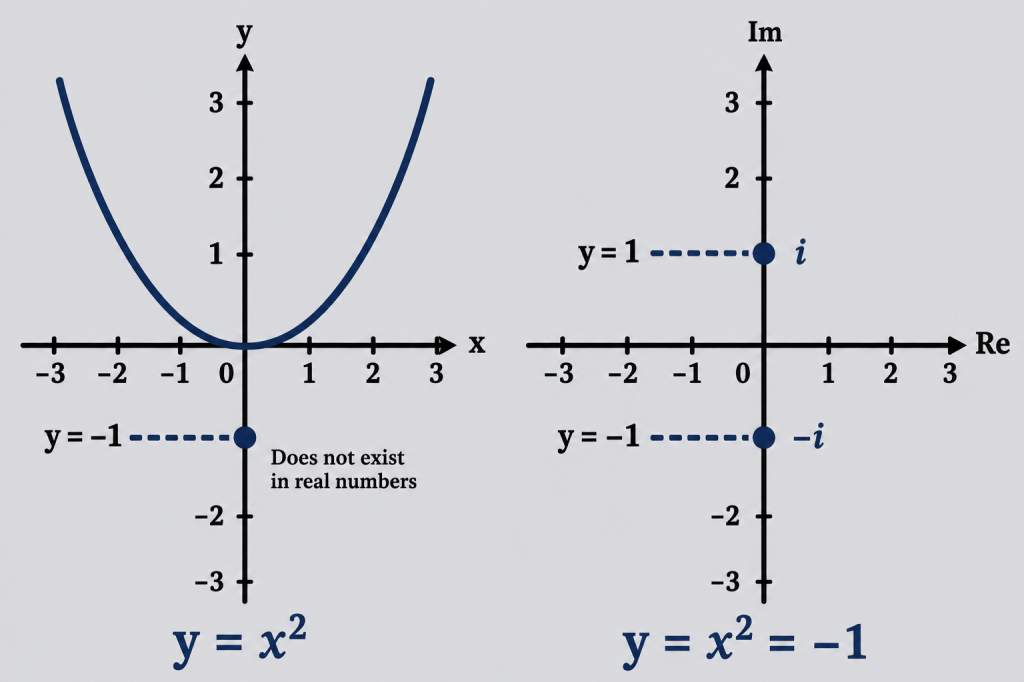
In the hopes of providing a reasonably attainable visual, an example is provided of the aforementioned developments in action, which allowed for a change[1] of known possible solution(s) for the above quadratic, y = f(x) = x2, with real solutions, x = ±b (where b is any constant integer).
The first graph shows the real-numbered solutions for the function y = x2, where it is evident that a solution at y = -1 (labeled for your convenience) does not exist[2]. The latter displays the solution using the complex imaginary axis, where y = x2 = -1 does in fact exist. One could pessimistically argue that instead of an infinite number of solutions, we are now limited to two, however, for the sake of my intended metaphor, lets instead suppose this imaginary axis has provided us with an additional two solutions.
The magnitude of this discovery essentially identified the breadth of this function as an extended infinity. Just like that, from the efforts of a few men, we witness an infinity that has somehow[3] amassed. I now offer my comparison, in which literature provides us all with an opportunity to add to infinity, to explore unthinkable possibilities, just like the various pioneers of mathematical beauty that came long before us, and those who will (hopefully) follow.
Clarifications & Technicalities:
[1] – note that I use the term ‘change’ in reference to the ensuing discovery of unknown solutions, not as an implication that these solutions were previously untrue.
[2] – on a graph, ‘does not exist’ means that there exists no possible input (denoted by x) in which the output (y) will result; essentially, the point (x,y) does not fall on the given graph; further, note that y will commonly be denoted as f(x), so (x,y) = (x, f(x)), I personally am partial to the notation f(x), because it reads more literally, ‘a function with an input of x’.
To understand a mathematical function in simpler English, think ‘what goes in must come out’: when an (x) value goes in, a (y) value must come out.
[3] – another technicality: in math, adding to infinity results in infinity, but for metaphorical purposes, we will pretend ‘infinity + 2’ is not entirely redundant.

